

Hyundai expands its IONIQ lineup with the all-new 2026 Ioniq 9, the first all-electric three-row crossover from the South Korean automaker. The Ioniq 9 has zippy acceleration, fast charging times, good range, a modern and spacious cabin, long list of standard features and tech, and is aimed at the family market with seating for up to seven passengers.
Base Price: $76,490
As Tested: $79,540
Horsepower: 422
Mileage: 91 MPGe mpg city/79 MPG3 mpg highway/85 MPGe mpg combined
The 2026 Ioniq 9 is similar in size to Hyundai’s very popular gas-powered Palisade, but has futuristic looks which stand out from other three-row crossovers. The interior also has modern flair and premium touches.
The three lower trims have seating for seven with bench seating in the second row, while the two top trims have room for six with captain’s chairs in the second row.
The 2026 Ioniq 9 comes in six trims: S RWD, SE AWD, SEL AWD, Performance Limited AWD, Performance Calligraphy AWD, and Performance Calligraphy Design AWD. Starting prices range from $58,955 to $76,490. While the higher trims are spendy, they are loaded with luxury-level niceties that make the Ioniq 9 a good value for the money.
The base S RWD has rear-wheel drive, as its name suggests. The other trims all come standard with all-wheel drive.
There are three motor configurations. All have a 110.3-kWh lithium-ion battery The S RWD has one electric motor with total output of 215 horsepower and 258 pound-feet of torque. The all-wheel drive SE AWD and SEL AWD models get dual electric motors with total output of 303 hp and 446 pound-feet. The Performance AWD models also get dual electric motors but have a more powerful front electric motor with a total output of 422 horses and 516 pound-feet.
Driving range is 335 miles for the S trim, 320 miles for the SE and SEL trims, and 311 miles for the Limited and Calligraphy trims.
Despite weighing about three tons, the Ioniq 9 has agile handling and is enjoyable to drive. That’s something you don’t always get in a three-row crossover. It’s quick off the line, as are most EVs, and there’s also plenty of power for merging and passing on the highway. Steering is light but accurate, and the Ioniq 9 feels planted when cornering. Brakes have a normal feel without the squishiness found on some regenerative braking systems. The ride is refined, quiet and smooth, as you want in a family hauler. Hyundai says the suspension has been designed for electric SUVs to give a plush ride.
Charging time is impressive. Hyundai says the battery can go from 10% to 80% in just 24 minutes using a 350-kW DC fast charger. The Ioniq 9 uses the NACS port, which is compatible with Tesla Superchargers, and includes adapters for other networks. Hyundai also offers bidirectional charging, so the vehicle can power home appliances during outages.
Fuel efficiency is competitive with other midsize EV SUVs. EPA ratings for the S trim are gets 103 MPGe city, 81 MPGe city with a combined rating of 92 MPGe. The SE and SEL trims get 98 MPGe/78 MPGe/88 MPGe. The Limited and Calligraphy trims get 91 MPGe/79 MPGe/85 MPGe.
When properly equipped, the RWD model can tow up to 3,500 pounds and the AWD models up to 5,000 pounds.
The cabin is upscale, roomy and comfortable. The design is modern with clean lines and attractive materials, several of which are recycled and/or sustainable. Adults enjoy plentiful leg- and headroom in the first and second row, and Relaxation Seats in the first and second rows can be fully reclined with leg rests – ideal for when you’re hanging out in the vehicle while it’s charging. As is usually the case, the third row is tight and best suited for kids, although average-size adults will be fine there on shorter trips. A12-inch instrument panel and large infotainment system flow together in one large, curved screen.
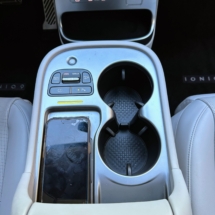
Standard features include remote start, proximity key entry, push button start, rearview camera with parking guidance, dual-zone climate control, eight-way power adjustable driver’s seat with power lumbar support, heated front seats, leather-wrapped steering wheel, 12.3-inch digital gauge cluster, infotainment system with 12.3-inch touchscreen, navigation, eight-speaker audio system, satellite radio, HD Radio, wireless Android Auto and Apple Car Play, Bluetooth, Seven type-C USB ports (three in the first row, two in the second row and two in the third row), wireless device charging, Wi-Fi hotspot, LED interior lights, rain-sensing windshield wipers, high beam assist, heated outside mirrors, and two 12-volt outlets (one in front and one in the cargo area).
Available features include Hyundai digital key (lets you unlock, lock, and start your car with your smartphone), surround-view camera system, head-up display, auto-dimming rearview mirror, memory settings for driver’s seat, eight-way power adjustable front passenger’s seat, ventilated front seats, ventilated second row seats, heated steering wheel, H-Tex trimmed seating, Bose premium audio system, ambient interior lighting, panoramic sunroof, and Vehicle to load (V2L) two-way on-board charger in the cargo area.
Standard driver assistance technologies include automatic emergency braking, lane departure warning, lane-keeping assist, adaptive cruise control with stop & go, blind-spot collision-avoidance assist, pedestrian and cyclist detection, rear cross-traffic collision-avoidance assist, parking distance warning and driver attention alert.
Available driver assistance technologies include forward collision avoidance assist with car/pedestrian/cyclist, junction turning/crossing, lane change oncoming, lane change side detection, and evasive steering assist, blind-spot view monitor (shows video of what’s in the vehicle’s blind spot when a turn signal is activated), lane keeping assist, lane following assist, Highway Driving Assist 2, Smart Cruise Control 2, intelligent speed limit assist, parking collision avoidance assist, remote smart parking assist, driver attention warning, forward attention warning, safe exist assist, and rear occupant alert.
The infotainment system looks great with its large, curved screen and crisp graphics. It’s user-friendly with logically arranged menus. Handy physical controls make it easy to adjust audio and climate settings. However, the system can be slow to respond to inputs. The Ioniq 9 uses over-the-air updates to download and install software updates, including infotainment and map updates. A very useful feature is route planning that helps you find the nearest EV chargers.
Cargo space is generous. The rear cargo area has 21.9 cubic feet with all three rows in place, 46.7 cubes with the second row folded, and 86.9 cubes with the second and third rows folded. There’s also 3.1 cubic feet in the frunk (front trunk), perfect for storing the charging cables. A power liftgate with automatic open is standard on all trims.
The Ioniq 9 gets Hyundai’s excellent warranty with a 5-year/60,000-mile new vehicle limited warranty, a 10-year/100,000-mile powertrain and hybrid/EV battery warranty, and a 7-year/unlimited anti-perforation warranty. The high-voltage electrical system is also covered for 10 years or 100,000 miles.
The good:
Modern, distinctive styling
Nimble handling for a three-row crossover
Fast charging times
Good range
Spacious, upscale cabin
Many standard and available features and tech
Standard wireless Android Auto and Apple CarPlay
Good value for the money
The not-so-good:
Higher trims are pricey
Infotainment system can be slow to respond
Pricing info:
My 2026 Hyundai IONIQ 9 Performance Calligraphy Design starts at $76,490. Gravity Gold Matte paint is $1,000. Carpeted floor mats are $230. The vehicle load adapter is $220. The delivery fee is $1,600, bringing the grand total to $79,540.
Bottom line:
Hyundai set the bar high for all-electric three-row crossovers with the debut of the 2026 Ioniq 9. This family hauler is thoughtfully designed with a good range, fast charging times, a comfortable, roomy and upscale cabin, and offers good value for the money. And its unique styling makes the Ioniq 9 stand out from other midsize SUVs.