

New AAA Research looks at growing acceptance of speeding and public support for countermeasures
PORTLAND, Ore., – “No one actually drives the speed limit.” Three in ten drivers agreed with that statement in a new study from the AAA Foundation for Traffic Safety, highlighting how speeding has become normalized on today’s roads.
The study finds that while most drivers agree that posted speed limits are appropriate, many also consider driving 10 mph over the limit acceptable, and nearly half believe keeping up with traffic is safer than obeying the posted limit.
Here are links to B-roll video, the technical report, and report summery.
These attitudes are concerning because speeding continues to have deadly consequences. According to the National Highway Traffic Safety Administration, speeding was a factor in nearly 30% of traffic fatalities in 2024. In Oregon, speeding was a factor in 30% of fatal crashes in 2024, according to NHTSA. Find details here.
The Study by the AAA Foundation for Traffic Safety finds that 45% of drivers nationally and 41% of drivers in Oregon consider themselves to be someone who speeds sometimes or frequently, while 55% of drivers nationally and 60% of Oregon drivers consider themselves to be a non-speeder or someone who rarely speeds.

The findings suggest many drivers aren’t speeding simply to save time – they’re often convincing themselves that speeding is the right choice for the situation.
Drivers’ top reasons for speeding:
- To get around slower drivers (31% nationally, 24% in Oregon)
- To reach their destination faster (25% nationally, 16% in Oregon)
- To avoid holding up traffic (21% nationally, 17% in Oregon)
- Because that’s just how I normally drive (19% nationally, 18% in Oregon
- Because the speed limit is set too low (17% nationally, 16% in Oregon)
Drivers’ top reasons to slow down:
- To avoid getting a ticket (79% nationally, 86% in Oregon)
- To avoid being involved in a crash (72% nationally, 77% in Oregon)
- Bad weather (60% nationally, 59% in Oregon)
- Because going over the speed limit is against the law (44% nationally, 53% in Oregon)
- Speeding puts other drivers at risk (50% nationally, 61% in Oregon)
Drivers’ beliefs about speeding:
- It’s safer for me to drive with the flow of traffic than obey the speed limit (49% nationally, 46% in Oregon)
- When I do speed, I don’t go so fast that I worry about dying if I’m involved in a crash (44% nationally, 45% in Oregon)
- No one actually drives the speed limit; speeding is just the norm nowadays (30% nationally, 24% in Oregon)
- Speed limits are targeted at the most inexperienced drivers to make sure everyone drives safety (16% nationally, 15% in Oregon)
- I speed all the time and I’ve never been pulled over (11% nationally, 8% in Oregon)
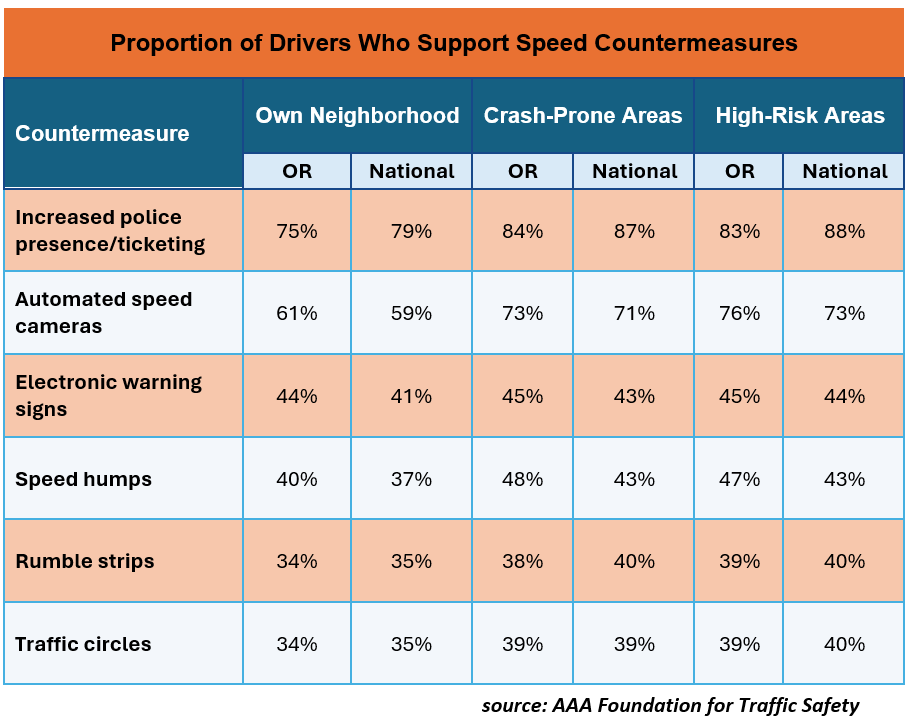
Drivers generally prefer countermeasures that encourage safer speeds over those that physically force them to slow down:
- Drivers expressed strong support for increased police presence in areas with a history (87% nationally, 84% in Oregon) or potential (88% nationally, 83% in Oregon) for speed-related crashes.
- About seven in ten drivers nationally and in Oregon supported automated speed cameras in those locations.
- Drivers also viewed advisory Intelligent Speed Assistance (ISA) – in-vehicle warnings or alerts when a driver exceeds the speed limit – more favorably than technology that automatically limits vehicle speed.
Drivers have less support for countermeasures that remove driver choices:
- Although more than nine in ten drivers believed speed humps are effective, fewer than half of all drivers supported installing them in their own neighborhoods.
- Support for Intelligent Speed Assistance (ISA) decreased as the technology became more restrictive, i.e. if the driver could not override the system.
- Interestingly, drivers were much more supportive of ISA systems in vehicles around them rather than having these systems in their own vehicles.
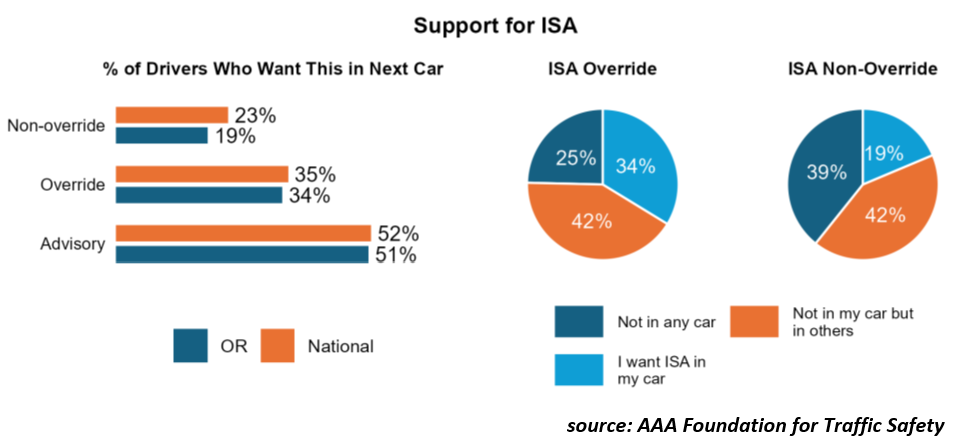
“Our study shows that drivers are more supportive of systems that control the speed of other vehicles, but don’t want the systems in their own cars. It reinforces findings from our previous studies that show drivers trust their own abilities behind the wheel over other drivers,” says Dodds.
AAA says you should choose your speed based on:
- The posted speed limit – think of it as a benchmark for a safe and appropriate speed. The posted speed limit is the maximum, not the minimum speed you should be driving.
- Visibility– whatyou can see determines how much time you have to react.
- Road conditions – weather and traction affect your ability to stop safely.
- Space around your vehicle – don’t let surrounding traffic dictate your speed; leave yourself enough room to respond to the unexpected.
If you find yourself driving the speed limit while everyone around you is speeding,
- Stay in the rightmost lane and avoid driving in the passing lane.
- Maintain a steady, predictable speed.
- Increase your following distance and watch for faster vehicles approaching from behind.
“Changing attitudes about speeding will take time, but drivers can make roads safer today by choosing appropriate speeds every time they get behind the wheel,” says Dodds. “Safe driving isn’t about how quickly you reach your destination or how fast everyone else is going. It’s about choosing a speed that gives you time to react to the unexpected, which can help prevent crashes.”
AAA news releases, high resolution images, broadcast-quality video, fact sheets and podcasts are available on the AAA NewsRoom at NewsRoom.AAA.com.
Find local news releases at https://oregon.aaa.com/community/media/media-contacts.html
For more info go www.AAA.com. AAA Oregon/Idaho provides 917,000 members with travel, insurance, financial and automotive-related services, and is an affiliate of AAA National, serving more than 65 million members in North America.