

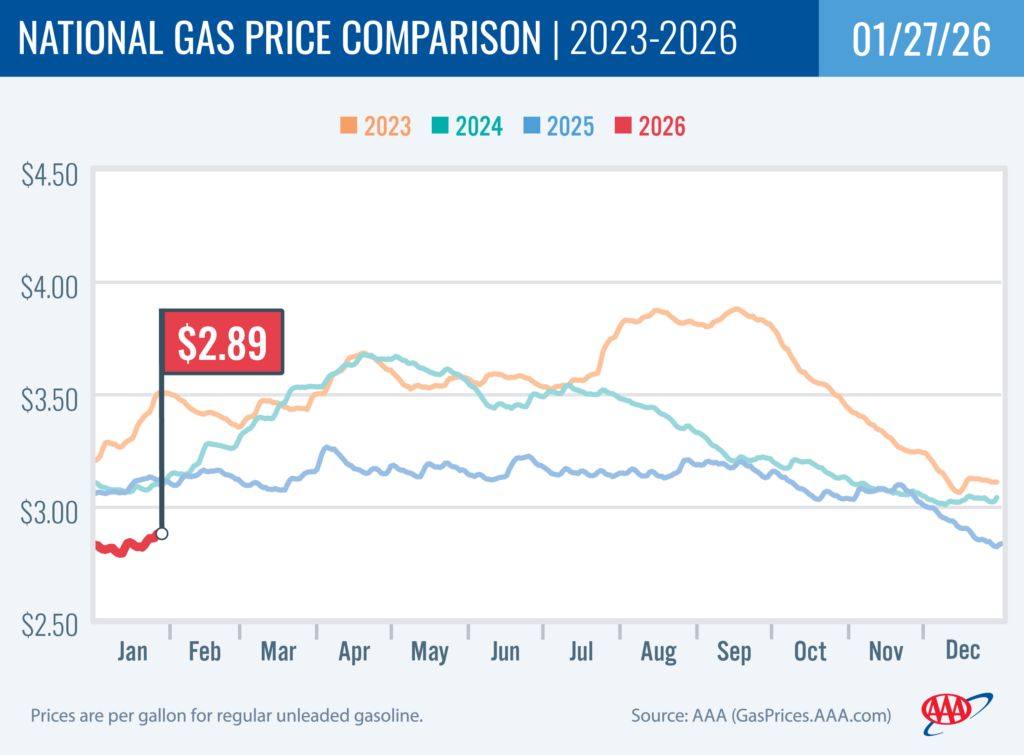
PORTLAND, Ore., – Higher crude oil prices are translating into higher pump prices. Various geo-political events have sent crude prices above $60 per barrel and the major winter storm that gripped much of the eastern U.S. has created some refinery issues. Pump prices are moving higher in most states, with some states seeing double-digit increases. For the week, the national average for regular adds seven cents to $2.89 a gallon. The Oregon average rises five cents to $3.38 a gallon.

“Crude oil prices remain above $60 per barrel and that’s causing pump prices to rise in most states. It’s a trend that could continue ahead of refinery maintenance season and the annual switch to summer-blend fuel,” says Marie Dodds, public affairs director for AAA Oregon/Idaho.
The Oregon average for regular gas began 2026 at $3.42 a gallon, which is the highest price of the year so far. The lowest price of the year so far is $3.33 on January 20.
The national average began 2026 at $2.83 a gallon, which is the highest price of the year so far. The lowest price of the year so far is $2.795 on January 11.
Demand for gasoline in the U.S. gasoline decreased from 8.30 million b/d to 7.83 million b/d for the week ending January 16. This compares to 8.09 million b/d a year ago. Total domestic supply of gasoline increased from 251 million barrels to 257 million. Gasoline production decreased last week, averaging 8.8 million barrels per day, compared to 9.03 million barrels he previous week.
Gas prices typically rise starting in mid-to-late winter and early spring as refineries undergo maintenance ahead of the switch to summer-blend fuel, which is more expensive to produce and less likely to evaporate in warmer temperatures. The switch occurs first in California, which is why pump prices on the West Coast often rise before other parts of the country. The East Coast is the last major market to switch to summer-blend fuel. Most areas have a May 1 compliance date for refiners and terminals, while most gas stations have a June 1 deadline to switch to selling summer-blend. Switch-over dates are earlier in California with some areas in the state requiring summer-blend fuel by April 1. Some refineries will begin maintenance and the switchover in February.
Gas prices usually drop in the fall, due to the switch from summer-blend to winter-blend fuel, which costs less to produce. The switch starts in September. Many areas, including Oregon, can sell winter-blend fuel starting September 15. However, Northern and Southern California require summer-blend fuel through October 31. Prices usually decline to their lowest levels of the year in late fall and early winter before increasing again in the late winter and early spring.
The U.S. price of crude oil (West Texas Intermediate) has mostly been in the upper $50s to mid-$70s since September 2024.
WTI is trading at $61 today, compared to $60 a week ago and $73 a year ago. In 2025, West Texas Intermediate ranged between $80.04 (January 15) and $57.46 (October 16) per barrel. In 2024, WTI ranged between $66 and $87 per barrel. In 2023, WTI ranged between $63 and $95 per barrel. WTI reached recent highs of $123.70 on March 8, 2022, shortly after the Russian invasion of Ukraine, and $122.11 per barrel on June 8, 2022. The all-time high for WTI crude oil is $147.27 in July 2008.
Crude prices are impacted by economic news as well as geopolitical events around the world including the current economic uncertainty, the current situation in Venezuela, tensions over Greenland, protests in Iran, sanctions on Iran’s oil, unrest in the Middle East, the conflict between Israel and Hamas, and the war between Russia and Ukraine. Russia is a top global oil producer, behind the U.S. and Saudi Arabia. Crude prices were volatile after the attack on Israel by Hamas in October 2023. While Israel and the Palestinian territory are not oil producers, there were concerns that the conflict could spread in the Middle East, which could potentially impact crude production in other oil-producing nations in the region. Crude oil prices declined after October’s fragile peace agreement between Israel and Hamas. In addition, production cuts by OPEC+ in previous years tightened global crude oil supplies, which continued to impact prices. But in 2025, the cartel boosted production which put downward pressure on crude oil prices. For 2026, OPEC+ says it’s not planning any production hikes in the first quarter of the year due to lower demand.
Crude oil is the main ingredient in gasoline and diesel, so pump prices are impacted by crude prices on the global markets. On average, about 47% of what we pay for in a gallon of gasoline is for the price of crude oil, 16% is refining, 20% distribution and marketing, and 17% are taxes, according to the U.S. Energy Information Administration.
Meanwhile, crude oil production in the U.S. remains at or near record highs. The U.S. Energy Information Administration (EIA) reports that crude production in his country is at 13.73 million barrels per day for the week ending January 16. Production has been at 13.5 million barrels per day many times since October 2024. The U.S. has been the top producer of crude oil in the world since 2018 and has been increasing its oil production since about 2009.
Quick stats
Oregon is one of 38 states and the District of Columbia with higher prices now than a week ago. Virginia (+13 cents) has the largest week-over-week increase in the nation. West Virginia (-3 cents) has the biggest week-over-week decrease in the country. The average in Connecticut is flat.
Hawaii ($4.41) has the most expensive gas in the nation for the seventh week in a row. California ($4.25) is second. These are the only states with averages at or above $4 a gallon. This week six states and the District of Columbia have averages in the $3-range. There are 42 states with an average in the $2 range this week.
The cheapest gas in the nation is in Oklahoma ($2.41) and Arkansas ($2.43) and. No state has had an average below $2 a gallon since January 7, 2021, when Mississippi and Texas were below that threshold. At the time, the COVID-19 pandemic drove significant declines in crude oil and gasoline demand in the U.S. and around the world.
The difference between the most expensive and least expensive states is $2.00 this week, compared to $2.10 a week ago.
Oregon is one of 22 states and the District of Columbia with lower prices now than a month ago. The national average is five cents more and the Oregon average is nine cents less than a month ago. Oregon has the second-largest month-over-month decline in the nation, behind Connecticut (-10 cents). Colorado (+30 cents) has the largest month-over-month increase.
Oregon is one of 49 states and the District of Columbia with lower prices now than a year ago. The national average is 23 cents less, while the Oregon average is 16 cents less. Wisconsin (-41 cents) has the largest year-over-year drop in the nation. Alaska (+17 cents) is the only state with a year-over-year increase.
West Coast
The West Coast region continues to have the most expensive pump prices in the nation with all seven states in the top 10. It’s typical for the West Coast to have six or seven states in the top 10 as this region tends to consistently have fairly tight supplies, consuming about as much gasoline as is produced. In addition, this region is located relatively far from parts of the country where oil drilling, production and refining occurs, so transportation costs are higher. And environmental programs in this region add to the cost of production, storage and distribution.
| Rank | Region | Price on 1/27/2026 |
| 1 | Hawaii | $4.41 |
| 2 | California | $4.25 |
| 3 | Washington | $3.87 |
| 4 | Alaska | $3.48 |
| 5 | Nevada | $3.39 |
| 6 | Oregon | $3.38 |
| 7 | District of Columbia | $3.11 |
| 8 | Pennsylvania | $3.02 |
| 9 | Maryland | $3.00 |
| 10 | Arizona | $2.98 |
As mentioned above, Hawaii has the most expensive gas in the country for the seventh consecutive week. California, Washington, Alaska, Nevada, and Oregon round out the top six. Arizona is 10th. Oregon is sixth for the third week in a row.
Five of the seven states in the West Coast region have week-over-week increases:
Washington (+6 cents), California (+5 cents), Oregon (+5 cents), Nevada (+3 cents), Alaska (+2 cents), and Arizona (+1 cent). Hawaii (-2/10ths of a cent) has a tiny week-over-week decline
The refinery utilization rate on the West Coast declined from 84.4% to 82.2% for the week ending January 16. This rate has ranged between about 70% to 93% in the last year. The latest national refinery utilization rate fell from 95.3% to 93.3%.
The refinery utilization rate measures how much crude oil refineries are processing as a percentage of their maximum capacity. A low or declining rate can put upward pressure on pump prices, while a high or rising rate can put downward pressure on pump prices.
According to EIA’s latest weekly report, total gas stocks in the region decreased from 31.60 million bbl. to 31.50 million bbl. for the week ending January 23. An increase in gasoline stocks can put downward pressure on pump prices, while a decrease in gasoline stocks can put upward pressure on pump prices.
Oil market dynamics
Crude oil prices remain above $60 this week as investors weigh various geopolitical events and the impact of this week’s major U.S. winter storm on oil production.
Meanwhile, the EIA reports that crude oil inventories increased by 3.6 million barrels from the previous week. At 426.0 million barrels, U.S. crude oil inventories are about 2% below the five-year average for this time of year.
At the close of Friday’s formal trading session, WTI jumped $1.71 to close at $61.07. At the close of Monday’s formal trading session, WTI slipped 44 cents to close at $60.63. Today crude is trading around $61, compared to $60 a week ago. Crude prices are about $13 less than a year ago. ($73.17 on January 27, 2025)
Drivers can find current gas prices along their route with the free AAA Mobile app for iPhone, iPad and Android. The app can also be used to map a route, find discounts, book a hotel and access AAA roadside assistance. Learn more at AAA.com/mobile.
Diesel
For the week, the national average jumps eight cents to $3.59 a gallon. The record high is $5.816 set on June 19, 2022. The Oregon average adds four cents to $4.01. The record high is $6.47 set on July 3, 2022. A year ago the national average for diesel was $3.67 and the Oregon average was $3.82.
Find current fuel prices at GasPrices.AAA.com.
AAA news releases, high resolution images, broadcast-quality video, fact sheets and podcasts are available on the AAA NewsRoom at NewsRoom.AAA.com.
Find local news releases at https://oregon.aaa.com/community/media/media-contacts.html
Fuel prices are updated daily at AAA’s Daily Fuel Gauge at AAA Fuel Prices. For more info go www.AAA.com. AAA Oregon/Idaho provides more than 910,000 members with travel, insurance, financial and automotive-related services, and is an affiliate of AAA National, serving more than 65 million members in North America.