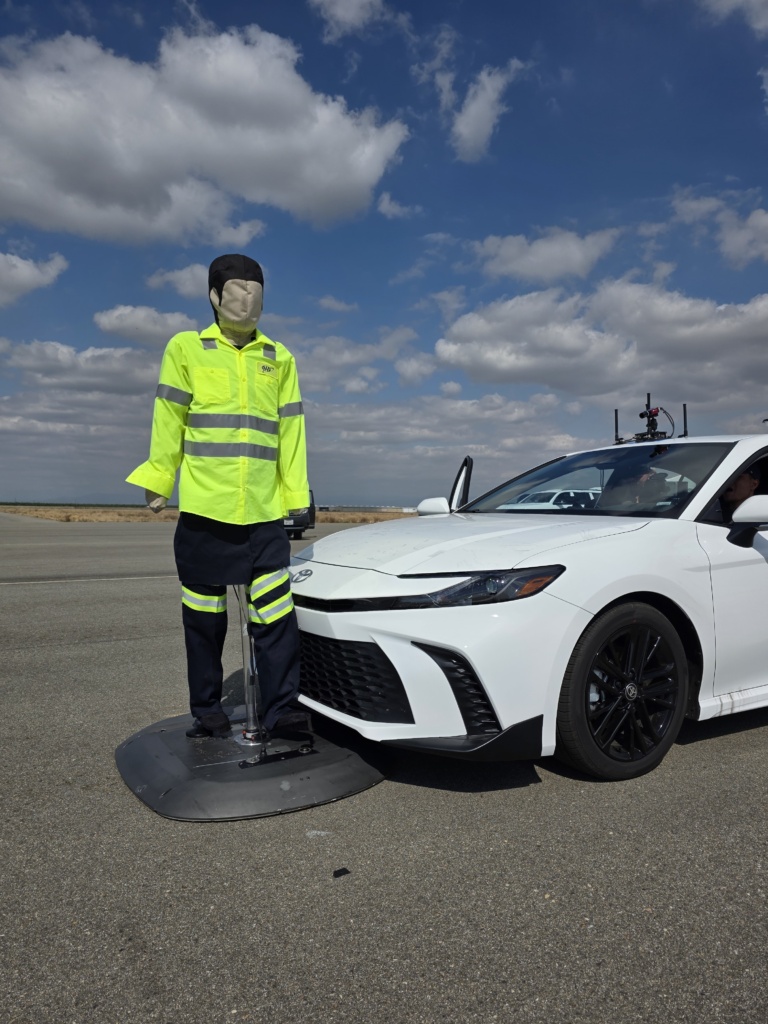

As vehicle braking systems improve, AAA celebrates the achievement while warning that dangerous gaps in effectiveness remain.
Pedestrian Automatic Emergency Braking (PAEB) is designed to detect pedestrians and automatically apply the brakes to prevent or minimize injury in a crash. During initial research in 2019, none of the vehicles that AAA tested avoided an impact with a pedestrian target at night. But in a recent follow-up, test vehicles showed a dramatic improvement to 60% effectiveness.
That’s encouraging, AAA says, because three-fourths of all pedestrian fatalities occur after dark. Further, pedestrian deaths in the U.S. have skyrocketed by 80% in the past 15 years – with the increase occurring mostly on urban arterial roads and at night.
“The technology has improved by leaps and bounds over the past six years, but we still have a long way to go. With current limitations, the chances of a vehicle “seeing” a pedestrian at night and reacting in time are nearly the equivalent of a coin toss,” says AAA Idaho public affairs director Matthew Conde. “It’s startling to learn that even wearing high-visibility clothing has mixed results.”
In addition to testing with a crash mannequin wearing non-reflective clothing, AAA also dressed the target in ANSI Class 3 high-visibility clothing – the kind normally used by emergency road workers and first responders. For test runs during the day, the high-visibility clothing had no negative impacts. But when the sun went down, test vehicles responded very differently, from improved avoidance to complete loss of detection.
“Joggers and first responders should continue to wear hi-vis clothing. You’re still making yourself more visible to human drivers – the first line of defense,” Conde said. “But as our research shows, shared vigilance is key to reducing the deaths and serious injuries on our roads.”
AAA recommendations
For drivers:
- Pedestrian Automatic Emergency Braking systems are not a substitute for an engaged driver.
- Drive with extra caution at night – the riskiest time for pedestrians.
- Ditch the distractions and drive sober.
- Review the owner’s manual to better understand how your vehicle operates.
For manufacturers:
- Continue enhancing the reliability of PAEB systems, especially at night and at higher speeds.
- Train the system to better recognize pedestrians of all sizes, including correctly interpreting the presence of emergency road workers and others wearing high-visibility clothing.
- Ensure that robust testing continues under a variety of lighting and weather conditions.
Slow Down, Move Over
Idaho Governor Brad Little recently proclaimed Saturday, October 18 to be Move Over Law Day here in the Gem State. AAA reminds drivers that every state has a law requiring drivers approaching a stationary emergency vehicle with flashing lights to slow down below the speed limit and, if possible, move over at least one lane to give workers more room to safely do their job.
AAA’s recent PAEB testing was completed at the Automobile Club of Southern California’s Automotive Research Center and was conducted on a closed course using roadways specifically designed to evaluate Advanced Driver Assistance Systems. Test vehicles traveled at 25 MPH and were presented with a pedestrian target crossing directly in front of the car.