

BOISE – “No one actually drives the speed limit.” Three in ten drivers agreed with that statement according to a new study from the AAA Foundation for Traffic Safety.
The belief that speeding is normal has dangerous consequences, as the National Highway Traffic Safety Administration recently identified excessive speed as a factor in nearly 30% of all fatal crashes in 2024.
“Again and again, crash tests prove that higher impact speeds are far more destructive than slower speeds. So, it’s not just how fast you are traveling – it’s whether you’ll have enough time and space to slow down,” says AAA Idaho public affairs director Matthew Conde. “Add in distraction, impairment, or a decision to not wear a seat belt, and things go from bad to worse.”
AAA’s findings suggest that drivers find a variety of reasons to justify speeding:
- To get around slower drivers (31%)
- To reach their destination faster (25%)
- To avoid holding up traffic (21%)
Surprisingly, more drivers say that they slow down to avoid getting a ticket (79%) than to avoid getting in a crash (72%), even though a crash is a much more expensive proposition.
“Vehicle repairs, medical bills, and property damage carry a higher price tag than most tickets ever could,” Conde said. “We’re asking drivers to reset their priorities around safety.”
Drivers express strong support (87%) for increased law enforcement in areas with a history or high potential for speed-related crashes. Drivers are also more supportive of advisory Intelligent Speed Assistance systems that warn drivers of excessive speeds rather than automatically reducing speed.
“It’s interesting to note that drivers were much more in favor of systems that controlled the speed of vehicles around them than their own,” Conde said. “It just shows you that people tend to trust their own judgment and driving ability over someone else’s.”
Improved safety infrastructure could also be part of the solution to reduce speeding. Nine in ten drivers believe that speed humps are effective, but fewer than half would want them installed in their own neighborhood.
Idaho-specific study results
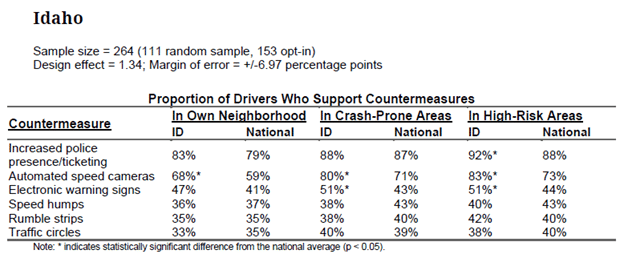
Overall, Idahoans expressed statistically higher support for police presence and electronic warning signs than the national data:
How fast should you drive?
Several factors should be considered when deciding how fast to drive in a particular situation:
- The posted speed limit – while not perfect in every case, it’s an important measure of what traffic safety engineers consider the maximum safe speed for the road under ideal conditions.
- Visibility – smoke, fog, rain, nighttime driving, and other factors may require a reduction in speed.
- Road conditions – Rain, snow, and ice can make it more challenging to drive at a safe speed and following distance. Traffic congestion and road construction can also be factors.
- Space around your vehicle – don’t let other drivers dictate what is safe; leave yourself enough time and room to react to the unexpected.
- Always think in terms of impact speed; lower impact speeds = higher survival rates.
“If you find yourself driving the speed limit while others are going faster, avoid driving in the passing lane and maintain a steady, predictable speed,” Conde said. “Speeding is a complex issue, and the Safe System approach envisions the right combination of vehicle design, infrastructure engineering, and safe actions behind the wheel.”