

Photo Courtesy: Dewa Sanzan
Reverence for Japan
Crafting travel poetry in Tohoku
Rain bends the cedar’s branch, exposes the spider’s web and pings off 350-year-old, hand-carved stones as we begin our 2,446-step ascent toward Mount Haguro. My jōe, traditional “pure cloth” I’ve donned as part of the Dewa Sanzan Pilgrimage, saturates as swiftly as the adjacent Haraigawa River has swollen in deference to the downfall. But who am I to whinge? The Yamabushi, a mountain monk who leads our party, pays the rain no mind, skipping lightly up each glistening step in equal defiance of the slick surface and his octogenarian age. Head bowed, I follow.
Photo Courtesy: Crai Bower
The Journey Begins
I traveled to Tōhoku, Japan, on Honshu’s northern peninsula, to hike, paddle and explore a lightly visited region best known for taking the brunt of the Great East Japan Earthquake and Tsunami in 2011. I hadn’t anticipated that within 90 minutes by bullet train from Tokyo vast swaths of wilderness would dominate this landscape.
Dewa Sanzan, a spiritual journey of renewal to mounts Haguro, Gassan and Yudono, begins with a morning cleansing ritual in the shukubo, or temple monastery house, where I had dined on shojin ryori, traditional mountain vegetables, and slept the previous night. I then pass through the red Zuishin Gate and descend toward the forest floor, level out beside the river, pass the 1,000-year-old Grandfather Cedar, and pause to admire the five-story pagoda, a 600-year-old wood structure puzzled together without a single nail.
The climb begins sharply, then shallows out somewhat at a monument and grove in honor of Bashō, Japan’s greatest haiku poet, who followed this pilgrimage in 1689—the highlight of my entire visit. I’ve loved the non-rhyming, 5-7-5 syllabic, nature-infused form of haiku since middle school. I once wrote a college midterm for my Nature and Philosophy class entirely in haiku, and I read Bashō most mornings while sipping tea in my plant-enveloped studio, followed by journal writing—a prework ritual I’ve maintained for decades.
My workspace cannot compare to the teahouse that is 1,000 steep steps on, where we perch to sip sencha tea as a vista unfurls, composed of forest, mountain and sky. Bashō ascended Mount Haguro during his 156-day, 1,491-mile Narrow Road to the Deep North sojourn. I reach the Dewa Sanza Shrine, board a shuttle and travel to Mount Yudono where I slither down a slick brae, navigate the Bonji River’s shallows and step, then stagger, beneath a powerful waterfall—the finale to my spiritual (and, as it turns out, physical) cleanse.
Photo Courtesy: Crai Bower
Awake in Nature
This integration of natural elements draws me back to Japanese culture again and again. Whether enshrouded within a cedar forest, paddling above a submerged tree line during the spring melt or slipping into onsen—natural hot springs—to soak after a 10-mile gravel bike ride, universal reverence for the environment never wavers.
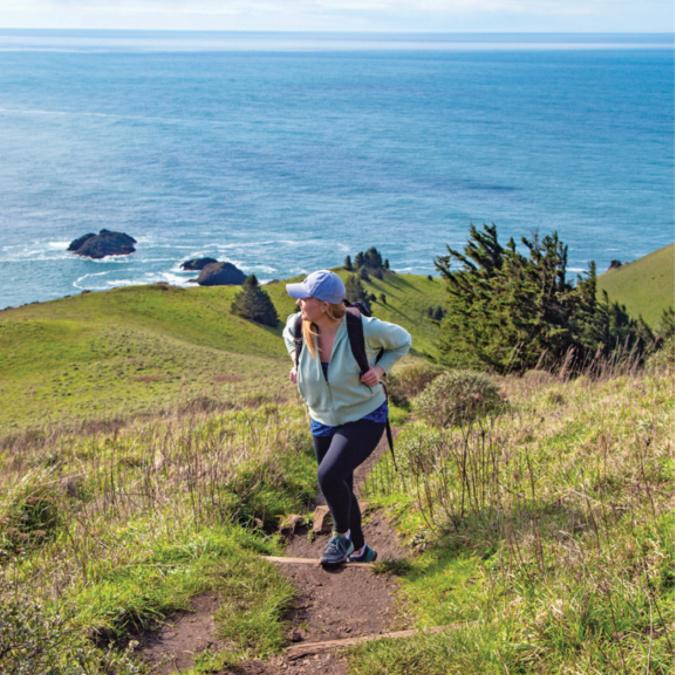
The Michinoku Coastal Trail (MCT) is the latest example of Japan’s efforts to expand access to wilderness. The name itself—Michinoku translates to “the end of the road”—speaks to Tohoku’s historical remoteness. The MCT opened in 2019, a key component of the area’s post-tsunami recovery. Like a sumo wrestler who refuses to budge in the face of an intimidating foe, the trail runs along the Pacific Ocean for more than 600 miles, a fantastic alternative to hiking Japan’s heavily touristed Kumano Kodo and Nakasendo routes.
Most visitors plan a day trip on the MCT, though I meet a few through-hikers traveling the entire 637-mile length while staying in ryokan, traditional inns that often offer affordable meals and, as importantly, onsen. Settling into these glorious geothermal spring-fed soaking tubs after one or many days on the trail is simply sublime, an opportunity to soothe one’s bones and further unclutter one’s brain.
Photo Courtesy: Crai Bower
Spiritual Gratitude
We begin our next day bowing and clapping—a sign of Shinto respect—at the Kabushima Shrine, located at the Tanesashi Coastline trailhead. We step onto the shoreline path bordered by late-blooming sea asters and endemic Hachinohe tohiren, two of the astounding 650 plant species awaiting discovery. A mellow path rises within a copse of century-old kuromatsu, or black pines. We reappear above Osuka Beach, a 1.4-mile span where our gait famously agitates the friction between quartz and sand to compose an audible, if off-key, aria.
It may be my close reading of Bashō—who wandered incessantly, often calling on hermits who’d, for decades, traveled no farther than a few footfalls from their sylvan huts—but Japan draws me into the musings of hermetic life like nowhere I’ve traveled. I attribute this current recluse fantasy to the lone matsu that clings to the jagged igneous outcroppings, the trunk’s haggard posture in compromise to the unforgiving gale. Gazing from a tabletop perch upon these solitary stewards, I question what in the wider world compels me to depart, ever.
Of course I rise, step gingerly down, rejoin my small group, and shuttle to the Kitayamazaki Cliffs, where we descend a narrow trail to isolated coves linked by a series of tunnels that lead to a mosaic of rocky beaches from scramble-worthy stones to smooth gravel. The arduous climb out reveals glorious views of the cerulean coves below and, beyond, the Pacific horizon.
I’m thrilled to get a paddle in my hand on our final day, after two days spent hiking along the shore. We kayak away from Jodogahama Beach, where white rhyolite rock forms a dragon’s back and tail that protects the inlet.
for these past days
giving thanks to the flowers
farewell
I lay my paddle across the bow, lean back to face the sun, and recall Bashō once more.
Travel experts at AAA can help you plan a trip to Japan and beyond, and include AAA member discounts. Contact your local AAA Travel Agent today at AAA.com/locations.
Crai S. Bower chases wildlife, trails and travel stories around the world. His award-winning writing and images appear annually in dozens of publications.







Travel Deals


