

Nearly 82 Million Americans Including 1.1 Million Oregonians will Travel for Thanksgiving
Updated November 27, 2025
PORTLAND, Ore., – AAA projects 81.8 million Americans (23.9% of the population) will travel 50 miles or more from home for the Thanksgiving holiday, up 2% from 2024. This year is the busiest ever for Thanksgiving travel, with an additional 1.6 million travelers compared to last year. About 1.17 million Oregonians will head over the river and through the woods for turkey and all the trimmings. The Thanksgiving holiday travel period is defined as Tuesday, November 25 through Monday, December 1.

“Thanksgiving is always the busiest travel holiday of the year as it’s all about spending time with loved ones. People are willing to navigate busy highways and crowded airports and will go the extra mile to create lasting memories from visits with family and friends,” says Doreen Loofburrow, senior vice president of travel for AAA Oregon/Idaho.
“Roads, airports, train stations, and cruise terminals will be stuffed like a Thanksgiving turkey, so expect plenty of company. Even with some remaining uncertainty around air travel, people are eager to carve out time to gather with loved ones and savor the holiday feast,” says Marie Dodds, public affairs director for AAA Oregon/Idaho.


Car travel to set new record
AAA projects 73 million Americans (89.6% of travelers) will drive to their Thanksgiving destination. This is a 1.8% increase and 1.3 million more travelers on the road compared to last year. These figures could end up being higher if people who want to avoid flying decide to drive instead. Even though the FAA has ended emergency flight restrictions, some travelers may have already decided not to fly this year.
In Oregon, roughly 1 million Thanksgiving travelers will drive.

For travelers who are renting cars, AAA car rental partner Hertz says Wednesday is expected to be the busiest pick-up day. The top 5 markets with the highest demand are Orlando, Atlanta, Las Vegas, Los Angeles, and Newark. According to AAA booking data, domestic car rentals are 15% cheaper this Thanksgiving compared to last year.
As drivers prepare to get behind the wheel, AAA and MADD remind travelers about the dangers of impaired driving. This time of year can be particularly deadly on the roads. According to the National Highway Traffic Safety Administration, from 2019 to 2023, the death toll in drunk-driving crashes during Thanksgiving festivities was 868, representing more than one-third (35%) of all fatalities in traffic crashes during that holiday period. Have a plan in place before Thanksgiving, and use a rideshare, designate a sober driver, or take public transit to ensure everyone’s safety.
Despite uncertainty, air travel shows growth
AAA expects 6 million U.S. travelers (7.4% of travelers) will fly to their Thanksgiving destinations, a 2% increase compared to 2024. The FAA has now lifted flight restrictions at 40 of the nation’s busiest airports, including the Portland International Airport. However, some travelers who planned to fly over Thanksgiving may still decide to shift to other travel modes, so the number of people flying over Thanksgiving could end up being lower. But AAA still expects the total number to be similar to recent years – the number of Thanksgiving air travelers over the past several years, with the exception of 2020 during the COVID pandemic, has been between 5 and 6 million.
Approximately 120,000 Oregonians will travel by air.

According to AAA booking data, a roundtrip domestic flight is averaging $700 which is similar to last year.
It’s cheaper to fly on Thanksgiving Day itself, but the flight home is what drives up the ticket price since Sunday and Monday are the busiest return days. Some travelers shorten or extend their Thanksgiving trips to avoid flying on peak days.
Find more below on the costs of all travel modes.
Advice for Air Travelers
- Be patient and flexible. Control what you can. Have a plan B, C and D.
- Book the first flight of the day or early morning flights if you can. They are less likely to be cancelled or delayed.
- Avoid booking tight connecting flights – you’ll want at least an hour to change flights in case your originating flight is late.
- If possible, avoid airports for connecting flights where winter weather can lead to delays and cancellations, including Chicago O’Hare, Newark Liberty, LaGuardia, Denver, and JFK.
- If you really need to be at your destination on a certain day, book flights a day or two early so that you have a buffer.
- Download the airline’s app on your phone and set it up for push notifications so that you’ll be notified about departure and arrival information as well as any flight changes, delays or cancellations. Also check the websites for your departure and arrival airports so you can get a complete look at flight operations on that day. FlightAware and other sites let you track your incoming flight so you can find other options if that flight is late or cancelled, and the site also provides a comprehensive look at all of the flights being cancelled or delayed in North America and around the world.
- Get to the airport early – at least two hours before domestic flights and three hours before international flights. The increase in travelers and possible shortages of TSA employees can make for longer than usual wait times to get through security.
- Avoid parking at the airport. Take transit, use a ride sharing service or get a ride with a friend. That way you won’t worry about your car if your return flight is delayed or cancelled, or you fly home through a different airport.
- If you need to park at the airport, book a parking spot in advance or at least check on availability before you go. Many airports including Portland International airport let you check current availability https://www.flypdx.com/Parking.
- Carry your bags on your flight instead of checking them. You may not be reunited with your bag in a timely fashion if your flights are cancelled or delayed. If you do need to check bags, bring medications, a change of clothes, comfortable shoes, and any other necessary items in your carry on bag. Make sure your bags have name tags, and also put your name and contact info inside each bag. Consider using an Apple AirTag, Samsung Galaxy SmartTag, or another tracker if you do check your bags.
- Plan ahead for meals and snacks. Full airports can mean long lines and wait times at restaurants. Bring a refillable water bottle and snacks. Many airlines allow you to pre-order food up to 24 hours before your flight. The TSA allows solid foods through screening but liquids or gels (such as yogurt) must comply with the 3-1-1 liquids rule.
- Consider signing up for TSA PreCheck, Global Entry and/or CLEAR to expedite the security screening process. Do make sure the airports you use offer CLEAR as it’s not available at all airports. Global Entry includes TSA PreCheck and is a good option when traveling internationally as it expedites the process at passport control when you’re coming back to the U.S.
Travel by bus, train and cruise also rises
Travel by other modes, including buses, trains, and cruises, will rise to nearly 2.5 million, an increase of 8.5% from 2024. It’s also possible that travelers who were planning to fly may switch to these modes this year so there could be a last-minute uptick.
Roughly 34,000 Oregonians will travel by these modes this year.

“Demand for cruises is building on its record post-pandemic growth. This year alone, AAA is projecting 20.7 million American cruise passengers. That number is even higher for 2026 with AAA forecasting 21.7 million U.S. travelers taking ocean cruises. Cruise vacations are appealing to family and friends during Thanksgiving because the trip is paid in advance, and there’s a wide variety of ships, amenities, and price points. Families can bring kids and grandparents, and there’s something for everyone on board,” says Loofburrow.
Olympic Pipeline closure puts upward pressure on gas prices; pipeline is now partially open
The Oregon average for regular gas is ticking up ahead of Thanksgiving. A driving factor in Oregon is this month’s outage on the Olympic Pipeline. BP, the operator of the pipeline, announced Tuesday (Nov. 25) that the pipeline has been partially reopened. Find details in this week’s AAA gas prices news release. Meanwhile the national average is fairly steady.
The Olympic Pipeline, the Pacific Northwest’s primary fuel artery, is partially open. The pipeline system consists of a 16-inch diameter pipeline and a 20-inch diameter pipeline. The system was shut down after a leak was detected near Everett, Washington on Nov. 11. Response crews did 24-hour excavation operations in the area and have identified the source of the leak on the 20-inch pipeline. BP says testing on the 16-inch pipeline found no indications of a leak and it was restarted early Tuesday.
The 400-mile pipeline system carries gasoline, diesel and jet fuel from refineries in Washington State to Portland. It also provides jet fuel to Sea-Tac International Airport. An outage on the pipeline in September caused gas prices in Oregon and Washington to soar. The Oregon average jumped about 32 cents after that outage.
“Impacts from the latest pipeline shutdown are not as dramatic as when the pipeline was out of service in September,” says Dodds. “So far, the Oregon average has only risen about four cents a gallon cent since this outage occurred. Now that the pipeline is partially open again, we expect pump prices here to resume their seasonal declines.”
Prior to the pipeline outage, pump prices had been relatively calm this fall. The Oregon average for regular gas had been mostly declining since mid-September, after a previous outage on the Olympic Pipeline ended. The national average has seen small ups and downs this fall but remains in the low $3 a gallon range.
“While Thanksgiving is a very busy holiday for driving, the increase in demand for gas doesn’t usually put much upward pressure on pump prices. The spike in demand occurs over a condensed time period, unlike the summer where we tend to see higher demand for the season. Thanksgiving also occurs at a time of year when the cheaper winter-blend fuel is available,” says Dodds.
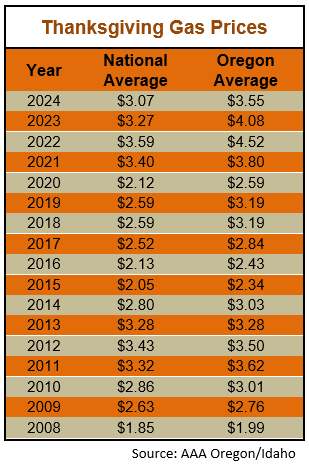
The current (as of Nov. 27) national average for regular unleaded is $3.03 and the Oregon average is $3.80.
Visit the AAA Fuel Prices website for current gas prices and EV charging costs (https://gasprices.aaa.com/).
Find news releases on Oregon gas prices here: https://info.oregon.aaa.com/oregon-gas-prices/
Find fuel saving tips here.
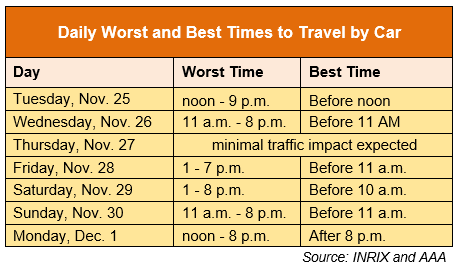
Best and worst times to drive; peak traffic expected Tuesday, Wednesday, Sunday and Monday
Drivers can expect the most congestion on Tuesday and Wednesday afternoons and evenings before Thanksgiving, and again on Sunday and Monday afternoons and evenings as travelers return home. INRIX, in collaboration with AAA, says metro areas across the U.S. could see more than double the delays versus typical drive times. The best time to drive is Thanksgiving Day when traffic is usually lightest, as well as in the mornings on other days.
“Drivers should hit the road in the morning to avoid the most congested times, but keep in mind construction, crashes, or wintry weather can also impact travel times. Please Slow Down, Move Over for emergency responders and other stopped vehicles on the side of the road to ensure everyone’s safety,” says Dodds.
AAA also recommends that travelers use traffic apps, local Department of Transportation notifications, 511 services, and listen to local radio for traffic reports to get real-time updates.
Here are projected travel times in and out of Portland:

Top Thanksgiving destinations
These are the trending destinations for domestic, international, and regional travel for members of AAA Oregon/Idaho based on bookings by our AAA travel agents and at AAA.com.
Theme parks, major cities, beaches, cruise ports are among the most popular spots. Fort Lauderdale is a busy departure spot for cruises. Munich, Germany is a popular place to stay before and after European River Cruises. Many South Pacific cruises depart from Sydney, Australia.

Holiday travel costs
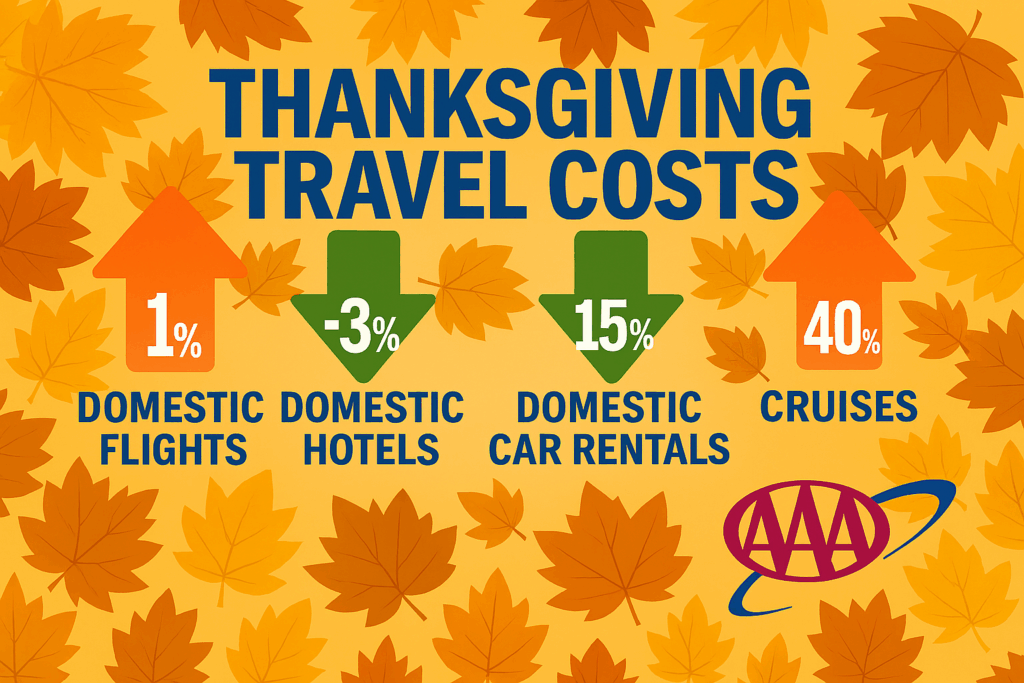
This Thanksgiving, AAA finds that flights, cruises, international car rentals, and tours are more expensive this year, while hotels and domestic rental cars are cheaper than last year.
“Thanksgiving can often cost less than other holidays for many travelers, because food, lodging and activities are usually family-driven which can help offset travel expenses,” says Dodds.
Here’s a breakdown of average booking prices, according to AAA data.
Flights
- The average price for a domestic roundtrip flight is $700, up 1% from 2024.
- The average price for an international roundtrip flight is $1,350, up 15% from last year.
Hotels
- The average booking cost for a domestic hotel stay (typically a few nights) is $590, down 3% from 2024.
- The average booking cost for an international hotel stay (typically a few nights) is $600, down 8% from last year.
Rental cars
- The average price for a domestic rental car (typically several days) is $400, down 15% from 2024.
- The average price for an international rental car (typically several days) is $450, up 2% from last year.
- AAA car rental partner Hertz says Wednesday is expected to be the busiest pick-up day.
- Hertz says the top rental cities are Orlando, Atlanta, Las Vegas, Los Angeles, and Newark
Cruises
- The average price for cruises departing from domestic cities is $1,650, up 40% compared to 2024.
- The average price for cruises departing from international cities is $4,800, up 30% from last year.
Tours
- The average price for a domestic tour is $1,000, up 65% compared to 2024.
- The average price for an international tour is $1,840, up 30% from last year.
What to know before you go – AAA tips for travelers
Consider working with a travel agent. They can help you plan the trip that meets your needs and comfort level this holiday season, provide the best value for your vacation dollars, explore travel insurance options, assist with any last-minute changes to travel plans, and act as an advocate if the unexpected happens.
Refunds for flight cancellations: Air travelers are eligible for refunds if their flight is cancelled and they choose not to accept a rebooked flight. Major airlines are required to automatically rebook passengers whose flights are canceled at no charge, or refund the airfare if the passenger decides not to accept the new flight.
Many major airlines are also waiving change fees and penalties for passengers who are looking to switch their flights on their own, though some carriers are applying limits. You’ll want to read the fine print.
Travel and medical insurance. AAA recommends travel insurance to cover unexpected delays or trip interruptions, especially if you’ve paid a lot of money for your trip. Travel insurance provides a safety net should something unexpected happen ahead of or during your trip. Travel insurance can cover expenses associated with flight cancellations, travel delays, lost luggage, and trip cancellation.
Read the fine print before purchasing a policy, or better yet, work with a travel agent who can help you get the policy that’s right for you. As far as travel insurance for delays and cancellations that are a result of lingering effects from the government shutdown, the shutdown is now considered to be a “known event” which means that if you purchased your policy on or after the date that the shutdown began, you may be excluded from coverage. If you purchased before September 30, you may still get some benefits, but it depends on the facts and circumstances of any scenario.
There are policies that are “Cancel for any reason” – these types of policies can provide coverage or partial reimbursement for cancellations, even if they are due to a “known event.” Again, read the fine print.
Medical travel insurance can provide coverage for illness and injuries and that may not be included in your regular health insurance plan. Medical insurance can be especially valuable if you are traveling outside the U.S. as people without medical insurance may have to pay up front for any services. Check with your health insurance provider. Travel agents can also advise on what medical travel insurance policy makes the most sense for your trip.
Get your car road-trip ready. Breakdowns are always a hassle, and you don’t want to be stranded during the Thanksgiving weekend. Find a trusted mechanic nearby at AAA.com/repair. Also be sure that your vehicle is ready for winter driving conditions. Get tips and advice, including what to put in your emergency kit, at AAA.com/winterprep (https://aaa.com/winterprep)
AAA to the rescue
Before you head out, be sure your vehicle is ready for the trip to avoid a breakdown along the way. Last Thanksgiving, AAA rescued 600,000 Americans including 6,500 Oregonians at the roadside. Dead batteries, flat tires and lockouts are the top three issues.
AAA makes it easy to request assistance – by phone (800-222-HELP) or the AAA Mobile App – and members can track the service technician’s progress as they make their way to your vehicle.
Before any long trip, AAA suggests getting an inspection to check key components such as the battery, fuel system, tires, brakes and fluid levels. Have your vehicle inspected by a trusted repair shop, such as one of the 7,000 AAA Approved Auto Repair facilities across North America.
Be prepared for emergencies with a mobile phone and car charger, and well-stocked emergency kit including a flashlight with extra batteries, first-aid kit, a basic toolkit, jackets and blankets, and drinking water and snacks for all passengers and pets. Share your itinerary with family or friends so that authorities know where to start looking for you if you don’t reach your destination.
“Bring enough water and non-perishable food items for you and your passengers, including pets, as well as extra jackets, warm clothing and blankets so that you have provisions if you get stranded. A wreck on a rural road can tie up traffic for hours, and not all areas have good cell phone coverage which can make it tough to call for help,” says Dodds.
Get tips and advice on how to plan for winter driving conditions at AAA.com/winterprep.
Forecast methodology
In cooperation with AAA, S&P Global Market Intelligence (SPGMI) developed a unique methodology to forecast actual domestic travel volumes. The economic variables used to forecast travel for the current holiday are leveraged from SPGMI’s proprietary databases. These data include macroeconomic drivers such as employment, output, household net worth, asset prices including stock indices, interest rates, housing market indicators, and variables related to travel and tourism, including gasoline prices, airline travel, and hotel stays. AAA and SPGMI have quantified holiday travel volumes going back to 2000.
Historical travel volume estimates come from MMGY’s TRAVEL PERFORMANCE/MonitorSM. The PERFORMANCE/MonitorSM is a comprehensive study measuring the travel behavior of U.S. residents. MMGY contacts over 50,000 U.S. households each month to obtain detailed travel data, resulting in the unique ability to estimate visitor volume and spending, identify trends, and forecast U.S. travel behavior, all after the trips have been taken.
The travel forecast is reported in person-trips. In particular, AAA and SPGMI forecast the total U.S. holiday travel volume and expected mode of transportation. The travel forecast presented in this report was prepared the week of October 20, 2025.
Because AAA holiday forecasts focus on domestic leisure travel only, comparisons to TSA passenger screening numbers should not be made. TSA data includes all passengers traveling on both domestic and international routes, whether traveling for work or leisure. Additionally, TSA screens passengers each time they enter secured areas of the airport, therefore each one-way trip is counted as a passenger tally. AAA focuses on person-trips, which include the full round-trip travel itinerary. As a result, direct comparisons of AAA forecast volumes and daily TSA screenings represent different factors.
INRIX Methodology
INRIX blends statistically grounded models with real-world road behavior to forecast travel conditions on the most heavily traveled routes across the U.S. during peak holiday periods. INRIX’s holiday traffic forecast combines pre-selected high-impact travel routes, rich multi-source traffic data, and a statistically robust linear regression model to generate detailed, time-specific travel delay predictions. INRIX’s data sources include a wide array of vehicle-based and infrastructure-based inputs. These include connected vehicle GPS data, mobile apps and navigation services, roadside sensors and cameras, and commercial fleet telematics. With expansive coverage, high temporal resolution, and historical context, this forecasting process provides essential insights for travelers, media, and agencies alike.
Thanksgiving Holiday Travel Period
The Thanksgiving holiday travel period is defined as the seven-day period from Tuesday, November 25 to Monday, December 1, 2025. This Thanksgiving travel window was instituted starting in 2024. Historical results were calculated dating back to 2019 using the same seven-day period.
About AAA
Founded in 1902 by automotive enthusiasts advocating for better roads and safer mobility, AAA has grown into one of North America’s largest and most trusted membership organizations. Guided by our mission to Save Lives, Create Member Value, and Deliver Exceptional Experiences, AAA provides world-class roadside assistance, travel planning, exclusive discounts, and reliable financial and insurance services. Today, AAA enhances the life journey of more than 65 million members across North America, including over 58 million in the United States. Learn more or become a member at AAA.com.
Find current fuel prices at GasPrices.AAA.com.
AAA news releases, high resolution images, broadcast-quality video, fact sheets and podcasts are available on the AAA NewsRoom at NewsRoom.AAA.com.
Find local news releases at https://oregon.aaa.com/community/media/media-contacts.html
Fuel prices are updated daily at AAA’s Daily Fuel Gauge at AAA Gas Prices. For more info go www.AAA.com. AAA Oregon/Idaho provides more than 919,000 members with travel, insurance, financial and automotive-related services, and is an affiliate of AAA National, serving more than 65 million members in North America.